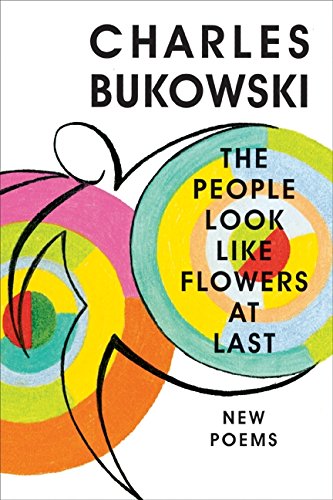



“if you read this after I am dead It means I made it” -“The Creation Coffin” The People Look like Flowers at Last is the last of five collections of never-before published poetry from the late great Dirty Old Man, Charles Bukowski. In it, he speaks on topics ranging from horse racing to military elephants, lost love to the fear of death. He writes extensively about writing, and about talking to people about writers such as Camus, Hemingway, and Stein. He writes about war and fatherhood and cats and women. Free from the pressure to present a consistent persona, these poems present less of an aggressively disruptive character, and more a world-weary and empathetic person. The purportedly "fifth and final" posthumous collection of Bukowski's inimitable poetry is also the ninth collection of it published since his 1994 demise. As the inscription on Buk's tombstone advises, "Don't try"--to make sense of his bibliography, that is. Do read the new addition to it, however. Like its predecessors, it contains four sections; the poems in each share a main concern. The first section's poems recall incidents from before Buk began publishing prolifically in 1960; the second's are about women; the third's, about the everyday madness of the famous writer's life; and the fourth's typify Buk's brand of (sometimes downright surreal) wisdom literature. Nearly all are amazingly funny, mordant, rueful, raffish, sad, resigned; all attest as firm a dedication to the lowercase as that of e. e. cummings. Standouts? Turn to "the dwarf with a punch" in section 1; the epical "Rimbaud be damned" in section 2; "I never bring my wife," with its sublime apothegm about the lonely, in section 4. Bet you'll then read the rest. Ray Olson Copyright © American Library Association. All rights reserved “The purportedly “fifth and final” posthumous collection of Bukowski’s inimitable poetry is. . . amazingly funny, mordant, rueful, raffish, sad, resigned; all attest as firm a dedication to the lower case as that of e. e. cummings. Standouts? Turn to “the dwarf with a punch” in section 1; the epical “Rimbaud be damned” in section 2; “I never bring my wife,” with its sublime apothegm about the lonely, in section 4. Bet you’ll then read the rest.” - Booklist " The People Look Like Flowers At Last is the final posthumous Bukowski collection. . . and it is extraordinary.” - Buffalo News “We all knew Bukowski was a tough guy, but who would have guessed that even the grave could not shut him up? The People Look Like Flowers At Last shows him at his scruffy, hard-hitting, tender-hearted best. They say this is his final posthumous book, but don’t bet on it.” - Billy Collins, former Poet Laureate “The purportedly “fifth and final” posthumous collection of Bukowski’s inimitable poetry is …amazingly funny, mordant, rueful, raffish, sad, resigned; all attest as firm a dedication to the lower case as that of e. e. cummings.” - Booklist the gas line is leaking, the bird is gone from the cage, the skyline is dotted with vultures; Benny finally got off the stuff and Betty now has a job as a waitress; and the chimney sweep was quite delicate as he giggled up through the soot. I walked miles through the city and recognized nothing as a giant claw ate at my stomach while the inside of my head felt airy as if I was about to go mad. it’s not so much that nothing means anything but more that it keeps meaning nothing, there’s no release, just gurus and self- appointed gods and hucksters. the more people say, the less there is to say. even the best books are dry sawdust. —from "fingernails; nostrils; shoelaces" Charles Bukowski is one of America’s best-known contemporary writers of poetry and prose and, many would claim, its most influential and imitated poet. He was born in 1920 in Andernach, Germany, to an American soldier father and a German mother, and brought to the United States at the age of two. He was raised in Los Angeles and lived there for over fifty years. He died in San Pedro, California, on March 9, 1994, at the age of seventy-three, shortly after completing his last novel, Pulp . Abel Debritto , a former Fulbright scholar and current Marie Curie fellow, works in the digital humanities. He is the author of Charles Bukowski, King of the Underground , and the editor of the Bukowski collections On Writing , On Cats , and On Love .